
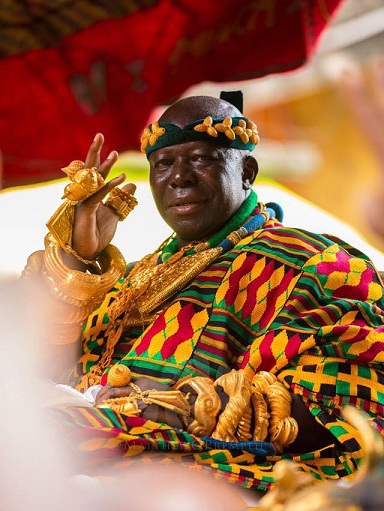

The Asantehene, Otumfuo Osei Tutu II, has firmly stated that no family or individual holds allodial ownership of land in Asanteman, emphasizing that such ownership belongs solely to traditional stools and is held in trust for the Golden Stool. His remarks come amid renewed disputes over lands belonging to the Kwame Nkrumah University of Science and Technology (KNUST), where some families have reportedly sought ownership through the courts.
Addressing participants during the Supreme Court’s 150th Anniversary Lecture Series in Kumasi, the Asantehene said increasing litigation over stool lands highlights the need for a better understanding of Ashanti customary land tenure. The event brought together judges, lawyers, traditional authorities, academics and policymakers to discuss the relationship between customary law and Ghana’s judicial system.
Otumfuo explained that under Ashanti customary law, allodial title is vested exclusively in the stools, which hold the land in trust for the Golden Stool. According to him, while families and individuals may enjoy customary rights to occupy or use land, those rights do not amount to ownership of the allodial title.
“There are no family allodial lands in Asanteman,” he stressed, adding that any legitimate interest in land within the kingdom must be linked to a recognized stool and supported by customary obligations. Families may possess leasehold or usufructuary interests, but they cannot claim absolute ownership of stool lands.
The Asantehene cited the ongoing controversy surrounding KNUST lands as an example of what he described as attempts to challenge long established customary ownership arrangements.
He recalled that the land on which KNUST sits was transferred through an agreement between one of his predecessors and Ghana’s first President, Dr Kwame Nkrumah. According to him, the land was properly surveyed and demarcated before it was allocated for the establishment and expansion of the university.
Otumfuo expressed concern that some individuals have pursued legal claims over extensive portions of the university’s land despite its historical ownership arrangement. He questioned attempts by some family representatives to seek ownership of more than one thousand acres through the courts, insisting such claims are inconsistent with Ashanti customary law.
His latest comments reinforce earlier warnings issued to chiefs, families and private individuals against encroaching on KNUST lands. As Chancellor of the university, the Asantehene has consistently maintained that the institution’s lands must be protected from unauthorized occupation and competing ownership claims.
Beyond the KNUST dispute, the Asantehene used the occasion to emphasize the importance of preserving Ghana’s customary legal traditions while strengthening collaboration between traditional authorities and the judiciary.
He noted that land disputes continue to generate uncertainty, fuel litigation and threaten social harmony in many communities. For that reason, he called for greater appreciation of customary law principles whenever land ownership issues arise in Asanteman.
Otumfuo also reminded legal practitioners and litigants that the Ashanti Confederacy resolved as far back as 1938 that all lands in Ashanti should vest in the stools in trust for the Golden Stool. He said this long standing customary position enjoys constitutional protection and remains the legal foundation for land ownership across Asanteman.
The Supreme Court’s anniversary lecture also provided a platform for discussions on improving the relationship between Ghana’s judicial system and traditional institutions. During the event, the Asantehene urged the judiciary to work closely with traditional authorities to ensure quicker resolution of chieftaincy and customary law disputes, arguing that prolonged legal battles often weaken public confidence in both institutions.
His latest remarks are expected to reignite conversations on land administration in the Ashanti Region, particularly as authorities continue efforts to protect public institutions such as KNUST from encroachment and competing ownership claims while safeguarding the integrity of customary land tenure.