

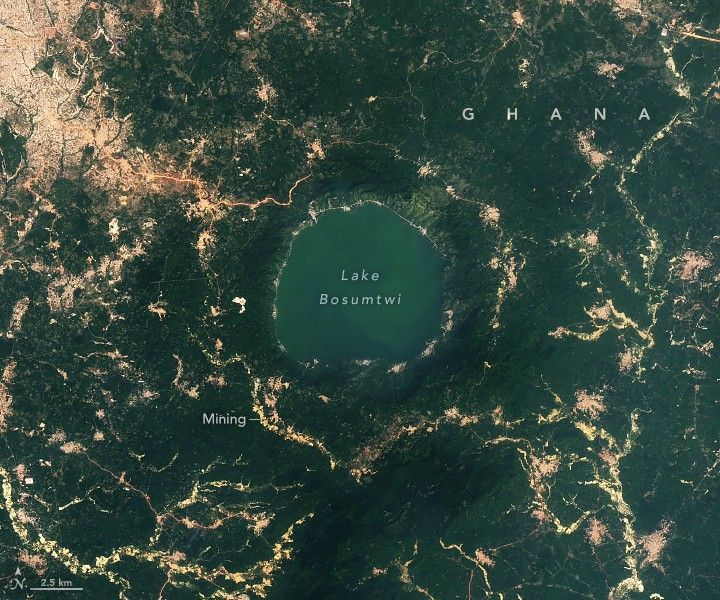
A newly released satellite image of Ghana’s famous Lake Bosomtwe has drawn global attention after showing shimmering gold colored patterns surrounding the country’s only natural lake.
The image, captured by NASA’s Landsat 8 satellite on December 21, 2024, highlights visible stretches of exposed land and mining activity around the sacred crater lake in the Ashanti Region. Scientists and environmental observers say the striking “gold glitters” seen from space are linked to increasing gold mining activities and land disturbances around the area.
Lake Bosomtwe, often referred to as Ghana’s “lake of souls,” remains one of the country’s most historically and scientifically important natural landmarks. The nearly circular lake spans about 49 square kilometers and is believed to have formed more than one million years ago after a massive asteroid struck the Earth.
According to NASA Earth Observatory reports cited in the publication, the impact created one of the world’s youngest and best preserved meteorite impact craters. Geological experts say the collision fractured rocks deep beneath the Earth’s surface, helping mineral rich deposits including gold become more exposed over time.
Comparisons between satellite images taken in 2015 and 2024 reportedly show a significant increase in mining activities around the lake over the last decade.
The newer imagery reveals expanding mining zones, especially in areas southwest of the lake, alongside growing farmland development and settlement expansion. Environmental experts say the changes are becoming increasingly visible from space because of large scale land clearing and exposed soil surfaces.
Senior University of Ghana Earth Science lecturer Marian Selorm Sapah described the visual contrast as a striking example of human driven environmental change occurring around a million year old geological site. “The stark visual evidence of anthropogenic change juxtaposed with a million-year-old geological landmark is striking,” Sapah said. “The clear encroachment of settlements, agriculture, and mining activities right up to the lake’s steep crater rim is a testament to both the image resolution and the scale of the change.”
The development has renewed conversations about environmental protection and sustainable mining practices in Ghana, particularly around ecologically sensitive and culturally important locations.
NASA’s Landsat taken on December 29, 2015

NASA’s Landsat taken on December 21, 2024
Scientists studying Ghana’s Lake Bosomtwe say the greener appearance seen in recent satellite images is likely connected to increased concentrations of phytoplankton in the lake.
According to environmental researchers, the color variation observed in 2024 compared to earlier years may reflect changing ecological conditions within Ghana’s only natural crater lake. Experts believe certain forms of phytoplankton have become more abundant due to seasonal environmental changes and growing human activity around the lake.


Beyond its scientific significance, Lake Bosomtwe occupies an important place in Ashanti culture and traditional beliefs.
According to local oral history, the lake was discovered by a hunter named Bompe who chased an antelope into a small body of water that mysteriously expanded into the lake known today. The name “Bosomtwe” is believed to combine the Twi words linked to a god and the antelope involved in the story.
Traditional beliefs among the Ashanti people also regard the lake as a sacred spiritual site where souls bid farewell before entering the afterlife. Because of this belief, fishing traditions on the lake historically prohibited the use of metal boats, with fishermen instead using wooden planks known locally as “padua.”
Today, several communities continue to live around the lake, relying on fishing, farming, tourism, and small scale economic activities for survival.
Environmental observers say the growing mining footprint around Lake Bosomtwe raises concerns about deforestation, water pollution, land degradation, and biodiversity loss.
The lake area is home to unique fish species and remains an important ecological zone within Ghana’s forest belt. Conservation groups have repeatedly warned that uncontrolled mining activities near water bodies could threaten ecosystems and local livelihoods if stronger environmental protections are not enforced.
Tourism experts also believe preserving the lake’s natural beauty is important because the site remains one of Ghana’s leading eco tourism destinations.
In recent years, Lake Bosomtwe has attracted both local and international tourists interested in hiking, canoe rides, cultural experiences, and scientific tourism linked to the crater lake’s rare geological history.
The latest satellite images have therefore sparked mixed reactions online, with some people fascinated by the breathtaking view from space while others expressed concern over the growing signs of environmental pressure around one of Ghana’s most treasured natural landmarks.
As discussions continue, environmental experts say balancing economic activity with conservation will remain critical to protecting Lake Bosomtwe for future generations.