
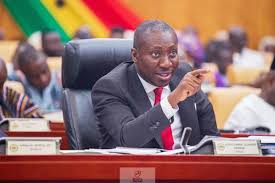

Minority Leader in Parliament, Alexander Afenyo-Markin, has called for the immediate and unconditional release of New Patriotic Party Bono Regional Chairman, Kwame Baffoe, popularly known as Abronye DC, following his remand into Bureau of National Investigations custody over controversial public comments.
The issue has quickly developed into a major political and legal debate in Ghana, with the opposition New Patriotic Party accusing the government of using state institutions to intimidate political opponents and suppress free expression.
Speaking at a press conference in Accra, Afenyo-Markin described the arrest, prosecution, and continued detention of Abronye DC as unconstitutional and politically motivated. According to him, the case represents a dangerous attack on democratic freedoms and civil liberties.
“The arrest, prosecution and remand of a citizen for words spoken in the public square is not justice. It is persecution,” the Minority Leader stated during the briefing.
Why Abronye DC Was Arrested
Abronye DC was arraigned before Circuit Court 9 in Accra on May 13, 2026 on charges of offensive conduct conducive to breach of the peace and publication of false news under Ghana’s Criminal Offences Act 1960 (Act 29). The charges are linked to remarks he allegedly made in a social media video criticizing the conduct and impartiality of a Circuit Court judge.
The court subsequently denied him bail and remanded him into BNI custody pending further proceedings. He is expected to reappear before the court later this month.
The prosecution reportedly opposed bail on grounds that Abronye DC could repeat the alleged offense if released. However, the Minority Leader strongly criticized that position, arguing that a person should not be detained simply because authorities fear future comments or political speech.
Questions Raised Over Remand Order
One of the major concerns raised by the NPP relates to the legality of the remand process itself.
Afenyo-Markin claimed that lawyers representing Abronye DC had repeatedly attempted to obtain a signed and certified remand order from the court registry without success. According to him, the absence of such documentation raises serious constitutional concerns regarding the legality of the detention.
“A remand order is not a verbal instruction. It is a formal judicial instrument,” he argued while questioning the legal basis upon which security agencies transferred Abronye DC into BNI custody.
The Minority Leader further questioned why a political communication case would involve the Bureau of National Investigations instead of a standard remand facility. He argued that the BNI exists primarily to address national security threats rather than political speech disputes.
NPP Alleges Political Intimidation
The opposition party believes the prosecution forms part of a broader pattern targeting NPP members and communicators.
During the press conference, Afenyo-Markin referenced previous arrests involving party activists and communicators, arguing that opposition voices are increasingly being subjected to criminal investigations and prosecutions.
He also urged civil society organizations, lawyers, journalists, and democratic institutions to speak out against what he described as growing threats to freedom of speech in Ghana.
The Minority Leader maintained that Ghana’s legal system already provides civil remedies for defamation and reputational disputes, making criminal prosecution unnecessary in cases involving political commentary.
Debate Over Free Speech and Criminal Law
The case has reignited public debate over the use of Sections 207 and 208 of the Criminal Offences Act in cases involving political expression and alleged misinformation.
Legal analysts and political observers continue to debate whether criminal prosecution should be used in matters involving controversial public commentary, especially after Ghana repealed its criminal libel laws more than two decades ago.
Some critics argue that criminal provisions relating to false publication and offensive conduct can potentially conflict with constitutional protections for free speech and political expression. Others insist that public figures must still be held accountable for statements capable of causing public disorder or undermining institutions.
The NPP says its legal team is preparing a constitutional challenge against the application of the laws in Abronye DC’s case.
Political Tensions Continue to Rise
The arrest and remand of Abronye DC have intensified political tensions between the governing administration and the opposition NPP at a time when national political discourse remains highly polarized.
Supporters of the opposition continue to demand his release, while government critics warn against the politicization of state institutions.
Meanwhile, the case is expected to remain under national attention as legal proceedings continue in court and political reactions intensify across the country.