


Another shocking EPL result of the season has been witnessed. Surprisingly, the League leaders, Arsenal got defeated by the struggling Manchester United side.
Arteta and his boys didn’t see this coming. These are the reasons they were outclassed by Manchester United in their 3:2 defeat.
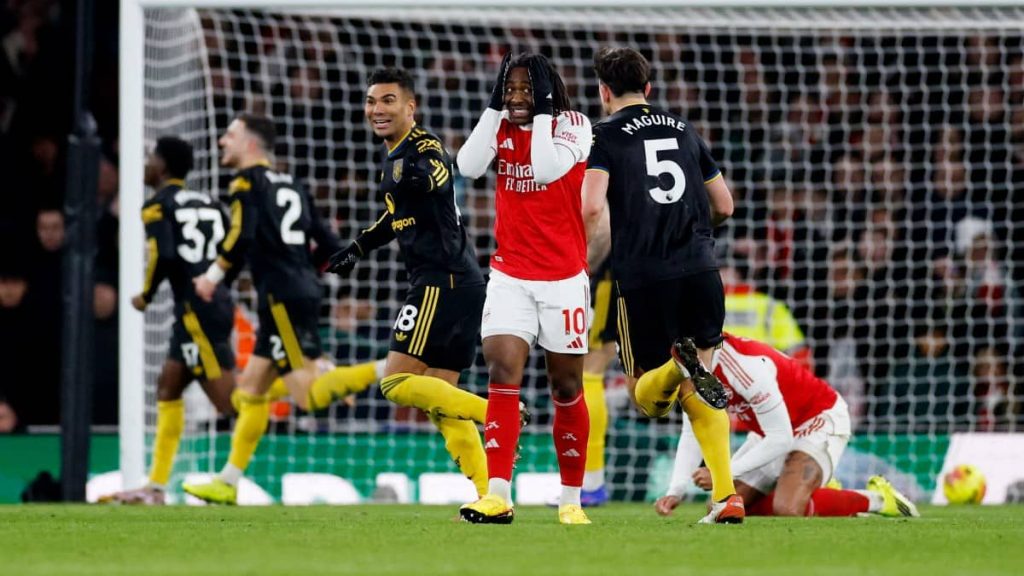
How Manchester United Outclassed Arsenal
1) They played a “low-risk” game while Arsenal played a “high-risk” game
Arsenal wanted to: dominate the ball, build slowly from the back and keep United pinned. Then create chances through patterns. That means Arsenal committed bodies forward: fullbacks are pushed high, midfielders are positioned between lines, and wingers held width. Unfortunately, that created spaces behind them.
On the other hand, United wanted: safety first, compact defending and quick counters into open space.
So Arsenal carried the responsibility of the game, but United carried the threat. This is why Arsenal looked like the “better team” in control, but Manchester looked “dangerous” when it mattered.
2) Manchester defended in a compact block (and blocked Arsenal’s best routes)
Arsenal’s danger usually comes from these areas: Zone 14 (central area outside the box), Half-spaces (left/right channels between fullback & CB), and Cutbacks after reaching the byline. Manchester’s defensive shape targeted those.
Thus, United kept short distance between midfield and defence and prevented Arsenal from playing clean central passes. This forced Arsenal to go wide more often. So Arsenal had the ball but kept being pushed toward crossing from less dangerous zones, passing sideways, taking long shots or rushed entries.
Possession without penetration: Arsenal “look busy” but create less.
3) Manchester won the transition battle (counterattack vs rest defence)
This is the BIG tactical point. Arsenal’s weakness today: when Arsenal attack, they leave only a few players behind for protection (rest defence), usually: 2 Center backs, 1 midfielder (sometimes). If that protection isn’t perfectly positioned, one pass can break the entire structure.
Manchester’s strength: When United won the ball, their first thought wasn’t “let’s keep possession.” It was rather “let’s attack BEFORE Arsenal recovers its shape.” So United did immediate vertical pass (1st or 2nd touch), wide release into space, runners in behind and quick finish. This is why United’s attacks felt “sudden” and “sharp” while Arsenal’s felt “heavy”.
4) Manchester took their chances better (clinical finishing)
This is where big teams punish you. Arsenal may create more “nice moments,” but if you miss chances or take bad final decisions, it means nothing.
Manchester were more ruthless: fewer touches in the box, quicker shot decisions, and better shot quality.
5) They turned Arsenal’s pressing against them
Arsenal press high with intensity. But high pressing has a cost: if the press is beaten, the defence is exposed and if the press is late, you get split open. If one player is bypassed, the entire structure suffers.
Manchester handled that by staying calm under pressure, picking the right moments to play long or quick and not forcing risky short passes repeatedly.
So Arsenal’s press sometimes became wasted energy, and United gained confidence as the match went on.
6) Manchester were mentally stronger in key moments
These “small” moments decide big matches. After going behind, United didn’t panic. Also, after equalising, they grew in belief. Moreover, when Arsenal tried to come back, United stayed composed.
United still had the “winner mentality”. Arsenal’s body language often becomes impatient when they don’t score early. That impatience can lead to rushed shots, forced passes, and over-committing men forward.
United waited for that moment and outshine Arsenal in a 3:2 win.